Skip to content
NK Immigration Consultants

NK Immigration Consultants

Search
  • NKIC
  • Canadian Immigration
  • Services
  • News
  • About Canada
  • About Us
  • Contact Us
Canadian Immigration

VAC service changes in Europe, Africa and the Middle East

September 26, 2019 nkic

Visa application centres (VACs) have contracts with the Government of Canada to give you visa application support services and biometrics services.

  • Current contracts with the VACs in Europe, Africa and the Middle East will be expiring on November 1, 2019.
  • New contracts will be starting on November 2, 2019, resulting in some service changes.

Before November 2, 2019, you can get the following services as a package at VACs in Europe, Africa and the Middle East:

  • submitting your paper application
  • sending your documents (such as passport) and returning them to you
  • collecting your biometrics (fingerprints and photograph) by appointment and/or walk-in

Starting November 2, 2019, VACs in Europe, Africa and the Middle East will require you to:

  • pay an extra fee to submit your paper application (fee is different by location)
  • make an appointment to provide your biometrics (no more walk-in)

New VAC websites will be launching for all VACs in Europe, Africa and the Middle East soon. More details about this change will be available in October.

Some VACs in the regions will also be closing.

We’re working with all VACs to ensure a smooth transition and to ensure that you receive the services you’ve paid for. Visit our VAC page regularly to stay updated and check your VAC’s website for details.

VACs closing permanently on November 29, 2019

  • Sofia, Bulgaria
  • Podgorica, Montenegro

The last day they will accept applications and collect biometrics is November 1, 2019. You can pick up your documents (such as passport) from November 4 to November 29, 2019.

Please Contact Us for more information.

NKIC Newsletter - September 2019
Citizenship by Investment - European Countries, Global Immigration Programs

Montenegro Citizenship by Investment Program

September 26, 2019 nkic

About Montenegro

Montenegro is a member of UN, WTO and NATO. Tourism is developing into a major industry in the country with tourist arrivals registering a 10% increase in 2018. While the country is a part of the Eurozone, full EU membership is expected by the end of 2025. Montenegro’s passport gives holders access to over 120 countries visa free including EU Schengen countries. Recognizing the potential of Montenegro, ARTON has launched its operations in the capital city of Podgorica in 2016 and has a fully operational office there. You can find more information about Montenegro on our website.

The Citizenship by Investment Program

As a part of its development strategy, the Government has launched, as of the beginning of 2019, a Citizenship by Investment program which aims at attracting FDI to support public projects as well as the development of the tourism sector. The Government has announced that it will limit the number of applications to 2,000 for a total period of 3 years starting on January 1, 2019, so I recommend that you seriously consider the opportunity to contribute to the development of the Montenegrin economy and make an investment in one of the fastest-growing economies in the Balkans.

General requirements and provisions of the program

Foreign investors and family members will need to meet certain criteria for enrolment in the program such as contribution thresholds and age of accompanying dependents. The Government has not set an exact minimum amount for the applicant’s net worth as a qualification threshold for the program. The general rule is that an applicant should be solvent enough to make the required investment and the contribution, pay the associated government and due diligence fees, and be able to support their dependents. All applicants must be of excellent health, be of an outstanding character and have clear criminal record.

Qualifying family members include:

  • Spouse – a person of the opposite sex to whom the applicant is legally married;
  • Children (whether by blood or adopted) provided that the principal applicant has legal custody over the child. Children over the age of 18 qualify if they are financially dependent on the principal applicant. In the case of adoption, all adoption papers will have to be disclosed.


    Investment options

    Applicants must make mandatory contribution to an approved Government fund and to make an investment in a real estate development that is approved by the program. 

    Currently, only one such project is approved, and we are pleased to provide information about this opportunity:
  • Project: Westin Hotel
  • Property manager: York Hotels & Reports under the franchise of Marriott International
  • Property owner: Kolasin Resort & SPA
  • Location: Kolasin town, which is in the northern part of the country. The development is located on the Ski Center 1450, just few meters away from the ski slopes
  • Investment option: fractional ownership (shares in the asset are sold to individual shareholders who share the benefits of the asset)
  • Investment capacity: the total number of investors in this project is 240. The project has already secured financing and it can be developed without the funds that the applicants under the program are expected to invest. Applicants who invest in the project will deposit their investment in an escrow account managed by independent auditors. It is estimated that investors will get an annual return of 4% on their investment after the project is operational.

    The investment must be kept for a period of 5 years as of the date of signing of the sale agreement for the property.


    Investment requirements

As of 2019, only one investment option is available – investment in real estate, with two categories:

  • €250,000 in approved properties located in an undeveloped region (in the northern region of Montenegro)
  • €450,000 in approved properties in a developed region (the coastline and the capital city of Podgorica)

In addition to that, applicants must make a non-refundable contribution (donation) to a state fund at the amount of €100,000 regardless of the investment category that they have chosen.

The above requirements apply per family, regardless of the number of applicants. 

Required documents

There are agreements and forms, civil status documents, documents related to business background and banking history, and other documents that applicants are required to provide. Some of these are required in copy and some must be originals. ARTON’s application analysts will guide and advise you throughout the process of document collection. To comply with its internal KYC policy, ARTON will request principal applicants and their spouse to send a clear copy of their valid passports and a CV of the principal applicant. Subject to successful completion of this internal procedure, applicants will be invited to sign a Client Facilitator Agreement with ARTON and will be onboarded for the process.

The process

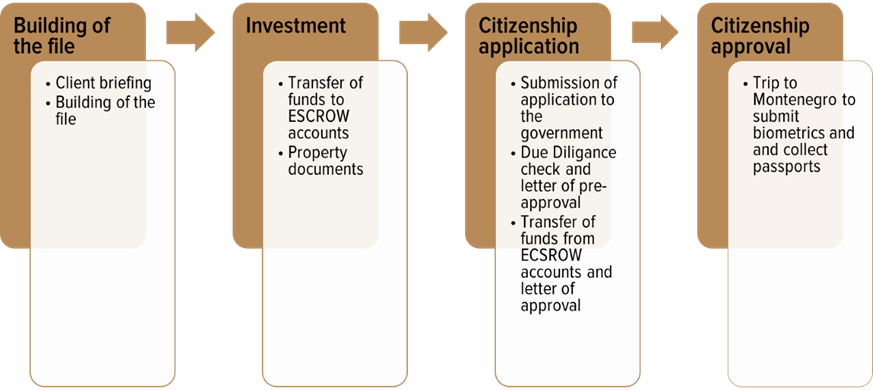
There are four main stages that successful applicants will undergo:

The time to complete the building of the file and investment stages are conditional to the client’s availability and resources. Once the application is submitted, it takes up to 3 months to complete the entire process for all applicants.

Disbursements associated with the application

The following disbursements must be made by the applicants

  • Investment amount and contribution amounts in accordance with the program thresholds:
    • €250,000 in approved properties located in an undeveloped region (in the northern region of Montenegro) or €450,000 in approved properties in a developed region (the coastline and the capital city of Podgorica)
    • €100,000 non-refundable contribution to a state fund
  • Government fees:
    • €15,000 for main applicant
    • €10,000 per dependent for up to 4 dependents
    • €50,000 fifth and next dependent, per person
  • Due diligence fees:
    • €7,000 for a single applicant
    • €10,000 for up to 4 dependents
    • €1,500 fifth and next dependent, per person
  • ARTON advisory fees:
    • €25,000 for the main applicant
    • €5,000 spouse/dependent child, per person


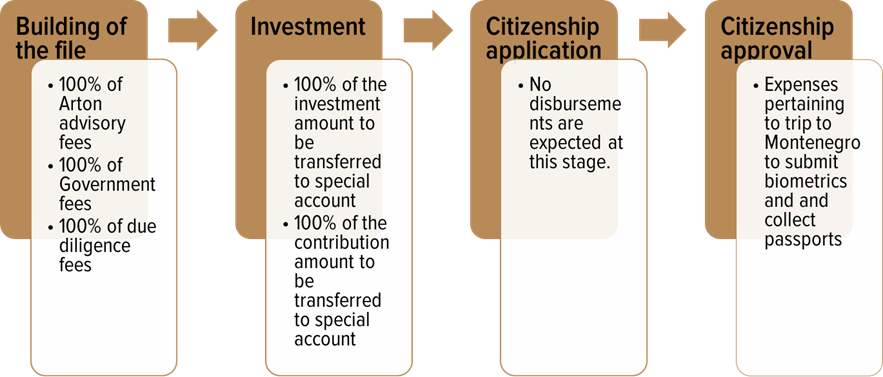
      Please see below the payment schedule:

Kindly note that applicants will also have to cover all costs pertaining to visa application, issuance, translation and authentication of documents, travel and accommodation expenses, bank fees and charges for all bank transfers, and other incidental costs based on their individual cases and family composition.

Please Contact Us for more information

NKIC Newsletter - September 2019
Canadian Immigration, News

Clarifying partner notification for HIV-positive cases

September 26, 2019 nkic

The instructions for HIV-positive cases have been updated to include justification for the partner notification procedure.

The following note has been added under the “Interview with a visa or immigration officer” section:

Note: IRCC attests that this policy is not intended to inflict unnecessary hardship on applicants or sponsors. Rather, it is a measure to protect the health and safety of the spouses and partners (residing in Canada) of applicants in the family and dependent refugee classes who test positive for HIV.

Procedure for HIV-positive cases

Automatic partner notification of sponsored family class applicants who test positive for HIV

Applicants in the family class and the dependent refugee class who test positive for HIV may not be assessed as medically inadmissible due to excessive demand on Canada’s health care system [A38(2)]. Their sexual partners residing in Canada must be made aware of the risk this serious medical condition may place on their health.

Automatic partner notification will give applicants in the family and dependant refugee classes who test positive for HIV 60 days from the date of being informed of the policy to voluntarily disclose their HIV-positive status to their spouse or partner or to withdraw their application. After this period, the Department will formally notify the spouse or partner of their dependants’ HIV-positive status before proceeding with the application.

To facilitate Immigration, Refugees and Citizenship Canada (IRCC)’s commitment toward public health and safety, this policy provides HIV-positive applicants with an appropriate window of opportunity to voluntarily disclose their medical status or withdraw their application.

Medical officers will continue to notify immigration program managers of cases where individuals test positive for HIV in both the family class and dependant refugee class. Although these cases are few, it is important that these instructions be followed accurately.

General overview of the policy

All permanent resident applicants who are 15 years of age or older, as well as children who have certain risk factors, such as having received blood or blood products, having a known HIV-positive mother or being potential adoptees are required to undergo an HIV test as part of the medical examination.

As part of this medical examination, the responsible panel physician will provide post-test counselling to HIV-positive applicants as per the handbook for designated medical practitioners. The panel physician will have the applicant sign the Acknowledgement of HIV post-test counselling form [IMM 5728E (PDF, 528.39KB)].

Applicants will then be required to attend an interview with a visa or immigration officer, where they will be informed of the Automatic partner notification policy for HIV-positive applicants in the family and dependant refugee classes and will be asked to sign the Acknowledgment of the automatic partner notification policy for HIV-positive applicants in the family and dependant refugee classes to indicate they’ve been informed of this policy. The officer should be satisfied that the applicant has understood the implications and been informed of the policy and should address any concerns the applicant may have with regard to their application.

The visa or immigration officer will then give the applicant 60 days to disclose their HIV-positive status to their spouse or partner residing in Canada or withdraw their application.

After 60 days have elapsed from the date of the interview, the officer will send a partner notification letter to the known spouse or partner in Canada.

In administering the automatic partner notification policy, it is essential that visa and immigration officers ensure the following:

  • that all applicants have signed the Acknowledgment of the automatic partner notification policy for HIV-positive applicants in the family and dependant refugee classes;
  • that all applicants clearly understand the implications of the policy, including the direct consequences of withdrawal of their application and of being HIV-positive (see Guidelines for witnesses);
  • that all applicants have been given 60 days to voluntarily disclose their status or withdraw their application before a formal notification is sent to the spouse or common-law or conjugal partner residing in Canada;
  • that case notes clearly reflect all counselling given to the applicant, the decisions agreed to by the applicant and the steps taken in completing the notification process.

Procedures

  1. Post-test counselling by a panel physician
  2. Identification of an HIV-Positive Applicant
  3. Interview with a visa or immigration officer
  4. Consequences after interview
  5. Consequences 60 days after interview
  6. Formal notification to the spouse or partner

1. Post-test counselling by a panel physician

The responsible panel physician will provide post-test counselling to HIV-positive applicants and will counsel them on the medical, social and psychological implications of being HIV-positive. Topics will include only those that have a pertinent medical theme and will not include any implications for the immigration application. The panel physician will have the applicant sign the Acknowledgement of post-test counselling form [IMM 5728E (PDF, 528.39KB)].

2. Identification of an HIV-positive applicant

  1. Responsible medical officer The responsible medical officer will notify the responsible immigration program manager in writing when an applicant who is exempt under subsection A38(2) tests positive for HIV, including any risk assessment made on public health or public safety grounds.
  2. Family class procedures For those who took advantage of the family class procedures, some applicants may already know their HIV status before missions have received their completed applications and created family class files. In such cases, missions should not initiate any partner notification process until a file has been created at the visa office and the applicant has completed all necessary counselling as per the instructions below.

3. Interview with a visa or immigration officer

  1. Verification of post-test counselling Given the serious medical, ethical and legal concerns involved when dealing with HIV-positive applicants, officers should ensure that all of these applicants are interviewed in person. Visa and immigration officers should not discuss the issue of partner notification with applicants who do not possess an Acknowledgement of HIV post-test counselling form [IMM 5728E (PDF, 528.39KB)]. If, during an interview, it becomes apparent that the applicant does not adequately understand the nature of their medical condition, the interview should be suspended. In these cases, the officer should advise the applicant to revisit the panel physician originally seen to seek further counselling and should request that another Acknowledgement of HIV post-test counselling form [IMM 5728E (PDF, 528.39KB)] be provided. Once the officer is satisfied that the applicant understands the implications of their medical condition, the officer should proceed with an explanation of the Automatic partner notification policy for HIV-positive applicants in the family and dependant refugee classes. Note: IRCC attests that this policy is not intended to inflict unnecessary hardship on applicants or sponsors. Rather, it is a measure to protect the health and safety of the spouses and partners (residing in Canada) of applicants in the family and dependent refugee classes who test positive for HIV.
  2. Explanation of the automatic partner notification policy It is the officer’s responsibility to explain to the applicant the Automatic partner notification policy for HIV-positive applicants in the family and dependant refugee classes. After determining that the applicant understands the policy, its potential consequences and the options available, the visa or immigration officer should ensure that the applicant
    1. has reviewed and signed the acknowledgment of the Automatic partner notification policy for HIV-positive applicants in the family and dependant refugee classes;
    2. has been provided with a copy of the automatic partner notification policy; and
    3. has been provided with a copy of the signed acknowledgement.
    Note: If an interpreter is required, the Interpreter declaration form should be completed. The instructions in Guidelines for witnesses (to be used by visa and immigration officers) should also be used, as necessary. Applicants should be advised that signing the Acknowledgment of the automatic partner notification policy for HIV-positive applicants in the family and dependant refugee classes will not in any way affect the processing of their application to completion. Applicants who do not sign the form should be advised that the form exists only to ensure that the Department has a record that the applicants have been informed of the policy and have had the opportunity to discuss their options under the policy. The visa or immigration officer should make sure all case notes reflect the counselling, the decisions and the steps taken between the visa or immigration officer and the applicant in completing the notification process.

4. Consequences after interview

  1. The applicant does not sign the acknowledgement of the automatic partner notification policy. Processing should continue with notes on file indicating that the applicant understood the policy but chose not to sign the acknowledgement. Such cases should be flagged to NHQ Litigation Management (BCL).
  2. The applicant expresses personal concerns, such as concern about a risk to their safety should their HIV status become known, that cannot be satisfied by standard counselling. Visa and immigration officers should advise the immigration program manager of such cases. They will be dealt with in consultation with International Region – Operational Coordination (RIM) and other headquarters divisions as appropriate.

5. Consequences 60 days after interview

Officers should ensure that 60 days have passed from the date of interview before continuing with processing the application as explained below.

  1. The applicant withdraws. Officers should process withdrawals by the applicant according to normal procedures.
  2. The sponsor withdraws. If the visa office is informed by the Case Processing Centre in Mississauga (CPC-M) that the sponsor (i.e., spouse or partner residing in Canada) has withdrawn the sponsorship, the visa office should refuse the application as per standard procedures using the refusal letter for sponsorship withdrawal.
  3. Neither the sponsor nor the applicant withdraws. If the visa office has not received notification from the CPC-M that the sponsor has withdrawn the sponsorship or if the applicant has not indicated that they wish to withdraw their application, case processing should resume to finalization.

6. Formal notification to the spouse or partner

If no withdrawals have been made by either the applicant or the sponsor, officers should prepare and send the partner notification letter, along with the HIV contact information in Canada handout, to known spouses or partners residing in Canada with copies on file. The visa or immigration officer should ensure that the spouse or partner’s address is the most current available by either requesting verification from the CPC-M for family class applicants or verifying the paper file of the dependant refugee class applicant.

Guidelines for witnesses (to be used by visa and immigration officers)

(For use by officers witnessing an applicant’s signature)

The following rules are general in nature and should be used by officers when completing any forms used to process HIV-positive applicants in the family and dependant refugee classes. They should not be considered all-inclusive.

It is important to ensure that the applicant fully understands the implications of being HIV-positive and/or of the Automatic partner notification policy for HIV-positive applicants in the family and dependant refugee classes. The officer should also find out whether an interpreter is required prior to convoking an interview and should use the interpreter declaration form when necessary.

General guidance

  • Do not obtain the applicant’s signature until the discussion of the automatic notification policy and the implications of testing positive for HIV have been completed.
  • Do not obtain a signature of consent from an applicant who is under the influence of medication that might affect their mental ability to make a decision regarding their understanding of the policy and any options available.
  • Fill in blanks in block letters that are clearly legible, in blue or black ink.
  • Make sure that the form is complete before the applicant signs it.
  • Have the form signed before the disclosure to the spouse or partner takes place.
  • If the applicant has any questions after the form is signed, delay acting on partner notification until the questions are answered.
  • Do not use terms that the applicant will not understand when explaining the automatic partner notification policy.
  • Do not make any additions, deletions or alterations to the form after the applicant signs it.
  • Make sure that the statement being signed by the applicant is correct.

Please Contact Us for more information

NKIC Newsletter - September 2019
Canadian Immigration, News

Temporary residents: Transit Without Visa Program

September 26, 2019 nkic

Certain foreign nationals may be eligible to transit through Canada without a visa if they meet all of the following criteria:

  • are a citizen of
    • Indonesia
    • Thailand
    • Taiwan (must be a passport without a personal identification number)
    • Philippines
  • hold a passport or travel document of the country of which they are a citizen
  • hold a valid visa to enter the United States (US)
  • have not overstayed the period of time they were authorized to remain in the US
  • are not under a removal or deportation order in the US
  • are destined for a third country, including their country of nationality
  • have the required travel documents (such as a valid visa) to enter their country of destination as well as the required travel documents for any countries through which they may transit
  • are travelling on an approved airline
  • are transiting through a participating Canadian international airport
  • hold a confirmed airline ticket for a flight that leaves Canada within 24 hours of arrival

Disruptions to travel through Canada

Passengers in some situations are no longer exempt under the Transit Without Visa (TWOV) Program from the visa requirement. They now need to see a border services officer for examination before they can continue travelling. This applies to passengers who

  • miss a connecting flight at a Canadian airport
  • are being refused entry to the US

Current Canadian participating airport

At present, the TWOV Program operates at the following airports:

  • Calgary International Airport
  • Toronto Pearson International Airport (Terminal 1 only)
  • Vancouver International Airport
  • Winnipeg James Armstrong Richardson International Airport

Note: Flying through Terminal 3 or needing to change terminals between flights at Toronto Pearson International Airport does not qualify passengers for the TWOV Program.

In order to be eligible for the TWOV Program, airlines must meet specific criteria, including the following:

  • meet all requirements to fly into Canada and to operate in Canadian airspace
  • fly to a TWOV-approved airport
  • have access to US in-transit pre-clearance (USITPC) facilities at the airport or to a sterile transit area for Fifth Freedom Right flights
  • hold a Memorandum of Understanding (MOU) with the Canada Border Services Agency (CBSA) that is in good standing, per section 280 of the Immigration and Refugee Protection Regulations (IRPR) (this MOU outlines the requirements for transporting passengers to Canada)
  • have signed a TWOV Program MOU with IRCC and the CBSA

Note: To exercise the Fifth Freedom Right, the airline’s home country must have obtained the necessary Fifth Freedom Right in its air agreements with both the bilateral partner country and the third country involved. For more information, contact Transport Canada.

Currently, the following airlines are eligible to transport passengers under the TWOV Program:

  • Air Canada
  • Air Canada Rouge
  • Air China
  • Air Georgian
  • Cathay Pacific
  • China Airlines
  • China Eastern Airlines
  • China Southern Airlines
  • Hainan Airlines
  • Jazz Aviation LP
  • Philippine Airlines
  • Sky Regional Airlines Inc.
  • WestJet
  • Xiamen Airlines

Please Contact Us for more information
NKIC Newsletter - September 2019
Canadian Immigration, News

Temporary residents: China Transit Program

September 26, 2019 nkic

In some cases, Chinese nationals flying between China and the United States (US) are able to transit through Canada without a Canadian visa. Chinese nationals do not need to apply under the China Transit Program (CTP) if they are in possession of both of the following:

  • a valid US visa
  • a valid passport issued by the authorities of the People’s Republic of China (not issued by Hong Kong Special Administrative Region or Macao Special Administrative Region)

They must also be transiting on either of the following:

  • an Air Canada flight through Montréal Pierre Elliott Trudeau International Airport
  • any approved carrier through
    • Calgary International Airport
    • Toronto Pearson International Airport (Terminal 1 only)
    • Vancouver International Airport
    • Winnipeg James Armstrong Richardson International Airport

Note: If a passenger does not meet all the requirements, they are not eligible for the CTP and need to apply for a transit visa.

Passengers travelling to or from the US

In addition to the conditions above, when travellers are arriving from or travelling to the US, they must meet the following conditions to qualify as a CTP passenger:

  • arrive in Canada from the US on a direct, non-stop flight with an approved airline and proceed to the Canada Border Services Agency (CBSA) area for clearance or remain in a sterile transit area while waiting for a connecting flight (passengers who leave the sterile transit area must go to the CBSA area for examination)
  • not be under a removal or deportation order
  • have had a valid US visa to enter the US and not have overstayed the period of time they were authorized to remain in the US
  • be destined for a third country, including their country of nationality, and have the required travel documents (such as a valid visa) to enter that third country as well as the required travel documents for any countries through which they may transit
  • hold a confirmed onward ticket for a flight that will leave Canada within 24 hours of arrival (no layover or overnight stay is permitted)

Currently, the following airlines are eligible to transport passengers under the CTP:

  • Air Canada
  • Air Canada Rouge
  • Air China
  • Air Georgian
  • Cathay Pacific
  • China Airlines
  • China Eastern Airlines
  • China Southern Airlines
  • Hainan Airlines
  • Jazz Aviation LP
  • Philippine Airlines
  • Sky Regional Airlines Inc.
  • WestJet
  • Xiamen Airlines

In addition, Chinese nationals participating in the CTP must have one of the following 15 cities as their last embarkation point:

  • Beijing
  • Chengdu
  • Fuzhou
  • Guangzhou
  • Harbin
  • Hong Kong
  • Manila
  • Nagoya
  • Osaka
  • Seoul (South Korea)
  • Shanghai
  • Shenyang
  • Taipei
  • Tokyo
  • Xiamen

Disruptions to travel through Canada

Passengers in some situations are no longer exempt under the CTP from the visa requirement. They now need to see a border services officer for examination before they can continue travelling. This applies to passengers who

  • miss a connecting flight at a Canadian airport
  • are being refused entry to the US

Please Contact Us for more information
NKIC Newsletter - September 2019

Posts navigation

← Previous 1 … 5 6 7 … 50 Next →
NK Immigration Consultants > News

Questions?

Please Contact Us

Follow Us!

Like UsJoin UsFollow Us

Global Immigration Consulting Services

Quick Links

  • NKIC Immigration Consultants
  • Canadian Immigration Programs
    • Canadian Permanent Residence Programs
      • Express Entry
        • Federal Skilled Workers
        • Federal Skilled Trades Program
        • Canadian Experience Class
      • Self-employed Persons
      • Start-up Visa
      • Live-in Caregivers
      • Family Sponsorships
      • Refugees
    • Canadian Temporary Residence Programs
      • Visit Canada
      • Study in Canada
      • Work in Canada
    • Provincial Nominee Programs
      • Alberta PNP
      • BC PNP
      • Manitoba PNP
      • New Brunswick PNP
      • Newfoundland and Labrador PNP
      • Northwest Territories Nominee Program
      • Nova Scotia PNP
      • Ontario PNP
      • PEI PNP
      • Saskatchewan PNP
      • Yukon PNP
    • Quebec Immigration
  • Services
    • School Programs
      • Simon Fraser University
      • The University of British Columbia
      • British Columbia Institute of Technology
      • The University of Toronto
      • Geneva Business School
    • Citizenship by Investment Programs
      • Antigua and Barbuda Citizenship by Investment Program
      • Cyprus Citizenship by Investment Program
      • Dominica Citizenship by Investment Program
      • Grenada Citizenship By Investment Program
      • St. Kitts and Nevis Citizenship by Investment Program
    • European Union Immigration Programs
      • Bulgaria Immigration Program
      • Cyprus Immigration Program
      • Hungary Immigration Program
      • Portugal Immigration Program
      • UK Immigrant Investor Program
    • USA EB-5 Immigration Program
  • News
  • About Canada
  • About Us
  • Contact Us
Proudly powered by WordPress