
Skip to content
NK Immigration Consultants

NK Immigration Consultants

Search
  • NKIC
  • Canadian Immigration
  • Services
  • News
  • About Canada
  • About Us
  • Contact Us
News, Provincial Nominee Programs

New Business Immigration Programs in Ontario

January 17, 2016 nkic

Entrepreneur and Corporate Streams

Canada’s most populated province, Ontario, has provided details on two new business immigration programs that are now open to eligible candidates wishing to invest in the Canadian economy. As the leader in attracting foreign direct investment of any province or state in North America, Ontario’s new business streams are likely to prove popular.
The Entrepreneur Stream and the Corporate Stream both operate under the Ontario Immigrant Nominee Program (OINP), a Provincial Nominee Program that allows Ontario to nominate individuals deemed to have credentials that would benefit the local labour market. Ontario is home to Canada’s capital city, Ottawa, and Canada’s largest city, Toronto, which is located close to other major North American markets.

The OINP Entrepreneur Stream

The OINP Entrepreneur Stream is designed to attract individuals who are looking to implement a new business initiative or buy an existing business in Ontario. The OINP Entrepreneur Stream operates on an ‘Expression of Interest’ model, whereby eligible participants must be invited to apply before they may submit a complete application.
Successful applicants will obtain a temporary work permit support letter, based on a performance agreement, to establish the business in Ontario. If the investment and job creation agreements outlined in the performance agreement are adhered to, entrepreneurs will have the opportunity to be nominated for Canadian permanent resident status through the OINP.

The OINP Corporate Stream

The OINP Corporate Stream helps and supports established international corporations looking to expand into Ontario or buy an existing business. Once the business has been successfully established, key staff are eligible to apply for a provincial nomination certificate, allowing them to eventually become permanent residents of Canada.
There are a range of requirements for this stream, with criteria covering the corporation, the investment, local job creation, key staff and employment.

How are the new business streams different from the old Investor category?

Ontario closed its OINP Investor category on October 29, 2015, and announced that details of the new business streams would be provided in due course. Now that these details are in the public domain, stakeholders are wondering how these options differ from each other, as well as how they compare with the now-defunct Investor category.

“The two new business immigration streams for Ontario really are a breath of fresh air. It looks like the government of Ontario has done its homework and noted what works in other regions of the world,” says Attorney David Cohen.

“The Entrepreneur Stream is not too dissimilar to the EB-5 program in the United States, the main difference being that the Ontario version, like many new Canadian immigration programs, operates under an Expression of Interest system. The main benefit of this to the province and candidates alike is that it is demand-driven; this should allow for quick program delivery processes, and applicants will know that they have actually been chosen by the government based on their strong profile.

“Meanwhile, the Corporate Stream is all about either taking a successful business operation and expanding it into one of the most open, diverse, and stable markets in the world, or identifying an existing business in Ontario and taking it to the next level. Successful applicants to either of these streams will be developing their careers and portfolios in a beautiful and thriving region of North America.”

Please Contact Us for more information.
NKIC Newsletter - January 2016
Family Class, News

Update on Work Permits for Spousal In-Canada PR Applications

January 17, 2016 nkic

Foreign nationals in Canada applying to immigrate as a spouse or common-law partner will continue to have the opportunity to work while waiting for their application to be finalized. A pilot program giving them open work permits is being extended for one year, until December 22, 2016.

To be eligible for an open work permit, you must be a spouse or common-law partner living in Canada who is being sponsored under the Spouse or common-law partner in Canada (SCLPC) class. You must have valid temporary resident status (as a visitor, student or worker) and live at the same address as your sponsor.

If you have already submitted an application for permanent residence under the SCLPC class but have not yet applied for an open work permit, you can complete the work permit application. Send your completed application, along with appropriate fee, to the Case Processing Centre in Vegreville at:
CPC – Vegreville
WP – Unit 777
6212–55 Avenue
Vegreville, AB
T9C 1X6

If you have already received approval in principle on your permanent residence application—meaning you received a letter from Immigration Refugees and Citizenship Canada stating you meet the permanent residence eligibility requirements but have not yet passed the medical, security and background checks for your family members or yourself—you may apply for an open work permit online.

If you were provided with a work permit under the initial pilot, you must apply for a work permit extension before it expires.

If you are submitting a new application under the SCLPC class, you may submit a work permit application at the same time as your sponsorship application, along with an application for permanent residence, under the SCLPC class. You must include the appropriate fees, and send all completed applications together to the Case Processing Centre in Mississauga.

Please Contact Us for more information.
NKIC Newsletter - January 2016
News, NKIC Newsletter, Quebec Immigration

Quebec Skilled Worker Immigration Selection System Update

January 15, 2016 nkic

Mon projet, Québec’s Online Management System is Launched in Anticipation of January 18, 2016 Reopening

The first week of 2016 has been a busy one for the Quebec Skilled Worker Program (QSWP), a Canadian immigration program designed to select newcomers who are likely to become economically established upon arrival in the province of Quebec. Effective December 31, 2015, the government of Quebec has made the criteria for area of training far less onerous than previously. Meanwhile, the Mon projet Québec online application management system was launched on January 5, 2016.

The QSWP allows eligible applicants to immigrate to Canada after receiving a Quebec Selection Certificate / certificat de selection du Québec (CSQ) from the government of Quebec. The next application intake for the QSWP is scheduled to begin on January 18, 2016, and may run until March 31, 2016 at the latest. A maximum of 2,800 applications will be accepted for processing during this intake period, and demand is expected to exceed supply. Consequently, it is likely that the cap will be reached prior to March 31.

Changes to points system: Area of Training and Level of Education

The QSWP is a points-based program. Points are awarded for a candidate’s area of training, work experience, language proficiency, age, prior relationship with Quebec, the human capital factors of the applicant’s spouse or common-law partner (if applicable), and whether or not the applicant has a validated job offer from an employer in Quebec. If an individual satisfies the minimum point requirement for these factors, he or she may then gain additional points for any accompanying dependent children and proof of financial self-sufficiency.

One of the distinctive characteristics of the QSWP, compared with other Canadian immigration programs, is that candidates have the opportunity to be awarded a significant number of points through having earned a diploma, degree or certificate in an area of training that meets Quebec labour market needs. Up to 16 points are available for this factor, but until last week applicants who obtained their diploma, degree or certificate more than five years ago were required to show relevant work experience in the field in order to obtain these points.

However, this is no longer the case. As of December 31, 2015, applicants may receive points under the area of training factor for their diploma, degree or certificate regardless of when it was earned, provided that it was obtained before the application was submitted.

The changes announced on December 31, 2015, can also have an impact on whether a candidate’s degree, diploma or certificate is counted toward his or her point total. The level of education being assessed under the QSWP must have been completed prior to submission in order for points to be awarded.

“While many stakeholders may have been waiting anxiously to see what Quebec’s much-anticipated online system would look like, this news in relation to how points are awarded may have slipped under the radar to some extent,” says Attorney David Cohen.
“Nonetheless, its importance should not be understated. In effect, Quebec is opening its doors to an increased number of potential newcomers. It is the latest welcome development to what was once a convoluted and drawn-out immigration process.”

The government of Quebec has made a number of changes to the QSWP over the past year, including the release of a new area of training list and the removal of the ‘adaptability’ factor/interview from the points-based program, which had the effect of lowering the pass mark required to obtain a CSQ. Taken together with the latest changes to the QSWP selection process, candidates who may not have been eligible during a previous application cycle of the program may now be eligible.

Mon projet Québec

Mon projet Québec is an online immigration application management system used by the Ministère de l’Immigration, de la Diversité et de l’Inclusion (MIDI) in order to process applications under the QSWP. It was launched on January 5, 2016 and, while some teething issues were encountered over the first two days of operation, the system appears to be functioning at an ever-improving level.

Mon projet Québec allows candidates to complete their application for a CSQ, make their payment online, follow the status of their application, make changes to their application, and access personal electronic messaging throughout the process. As of January, 2016, QSWP candidates must use the secure space Mon projet Québec in order to submit an application.

The Mon projet Québec system allows a limited number of users to access the system at any one time. When users access the system, they create a user name and password. An activation link is then sent to the user’s personal email address; this activation link must be activated within 72 hours, otherwise the user must start over.
Candidates have up to 90 days to submit an application from the time they started to complete the application in Mon projet Québec. Once the application has been submitted, candidates will have 30 days to pay government processing fees. If a candidate does not submit within the prescribed time frame, the application will be deleted.

Quebec Skilled Worker: Present and Future

Quebec’s Minister of Immigration recently proposed a bill that, if passed, could result in Quebec implementing an Expression of Interest system similar to the Express Entry system currently used by the government of Canada. The upcoming application intake period may be the last application cycle where Quebec uses a first-come, first-served Skilled Worker Program.

The QSWP may be an enticing option for individuals who wish to make an application to immigrate to Canada without having to be invited to apply, as well as individuals who are in the Express Entry pool and wish to increase their chances of successfully immigrating to Canada. According to the governments of Quebec and Canada, candidates can apply under the QSWP and submit an Express Entry profile, as long as they withdraw one when either a CSQ or Invitation to Apply (ITA) is issued.

Please Contact Us for more information.

NKIC Newsletter - January 2016
Express Entry, News, NKIC Newsletter

Next Steps If No EE Invitation to Apply is Received Within a Year

January 15, 2016 nkic

Twelve months after the initial launch of Canada’s Express Entry immigration selection system, candidates who were quick to create an Express Entry profile last year are being advised on how they may realize their Canadian immigration goals during 2016.

Many candidates in the Express Entry pool are becoming more proactive in their pursuit of Canadian permanent resident status. For some, this entails a renewed effort to increase their Comprehensive Ranking System (CRS) score, while others are focusing more on immigration options outside the Express Entry system; indeed, both strategies may be pursued simultaneously.

A candidate for immigration to Canada under Express Entry can only stay in the Express Entry pool for one year from the date he or she was accepted into it. The profile will be deleted after one year, though a new one may be created. In any event, candidates in the Express Entry pool, as well as those considering entering the pool in 2016, may have cause for optimism due to some recent comments from CIC.

CRS point requirement expected to decrease in 2016

As covered in the previous edition of CIC News, a CIC Policy Analyst made some important announcements regarding the short- and medium-term future of Express Entry at a webinar hosted by CIC on December 16, 2015:
“The number of invitations issued per round is expected to increase as the pre-Express Entry inventory of applications is finalised. In turn, it is expected that the minimum score of those that are invited to apply will drop,” she stated, adding that “we expect that in the new year when our rounds start growing — to meet our new levels plan — that the score will reduce.”
These on-the-record comments have galvanized some candidates who, in spite of not having yet received an Invitation to Apply (ITA) for Canadian permanent residence, remain confident that they may receive an ITA. As such, it is expected that many candidates will create new profiles over the opening months of 2016. Indeed, the first Express Entry draw of 2016 has already taken place, with 1,463 candidates receiving ITAs on January 6.

Creating a new Express Entry profile

Citizenship and Immigration Canada (CIC) advises candidates who anticipate having to create a new profile to ‘save screen shots of (or print out) your profile to make it easier to re-enter your data. Do not create a new profile until your existing one expires. You can create a new profile at any time once yours expires.’
Candidates in this situation should note that they will have 60 days to fill out and validate the information in their profile. If they still meet minimum entry criteria, a new Express Entry profile number and Job Seeker Validation Code will be provided.
These numbers should be used to update the Job Match account in the Job Bank, if applicable. This step is necessary for candidates without a qualifying job offer or a nomination from a province or territory.
Once a profile is created, candidates can try to improve their core human capital factors by improving their language test results, by completing an additional year of work experience, and/or by completing a higher level of education. Certain candidates may also benefit from their spouse or common-law partner’s core human capital factors being considered, if applicable. In addition, candidates can initiate or improve a successful strategy to connect with Canadian recruiters and employers.
Candidates who decide not to create a new Express Entry profile are advised to remove any references that they are a candidate for Express Entry from any private job board websites, if they used any.

Canadian immigration options outside the Express Entry system

Candidates in the Express Entry pool, as well as other individuals interested in immigrating to Canada, should note that Express Entry is an application management system for only a handful of immigration programs. At the same time, there are other programs — the Provincial Nominee Programs — that have immigration streams that operate outside the Express Entry system. Many individuals are expected to make a successful application to one of these programs in 2016.
For example, the Saskatchewan Immigrant Nominee Program (SINP) International Skilled Workers – Occupations In-Demand sub-category, which exists outside Express Entry, was one of many sub-categories that reopened for applications this week. Within a few hours, however, the application cap had been reached. Many, if not all, of those who managed to submit an application had done prior research and preparation, allowing them to be ready to make an application when the program reopened.
In addition, there have been many positive developments with respect to the Quebec Skilled Worker Program (QSWP) over recent days, weeks and months. To read more about this on CIC News.
The QSWP and SINP are only two of many non-Express Entry Canadian immigration options.

From transition to new opportunities

“We don’t know the extent to which the scores may decrease or how the system may change in the future, or when. However, most of the recent signals are positive, and candidates who have not yet received an Invitation to Apply should take heart,” says Attorney David Cohen.
“Candidates in the pool are visible, so to speak, to the Canadian provinces that are looking to welcome newcomers through the Provincial Nominee Programs. People are also realizing that a candidate in the pool has far more leverage when discussing a possible job opportunity with a Canadian employer than a candidate who is not in the pool.
“Moreover, it might well be the case that some candidates have been so focused on Express Entry that they haven’t fully grasped that there are many paths to Canada. Some lateral thinking may be required in order to fulfil one’s Canadian immigration dreams. To this end, candidates should note that Canada has a highly decentralized immigration system in which the provinces are also able to select newcomers, and many of these programs operate outside the Express Entry system.”

Please Contact Us for more information.

Read more at http://www.cicnews.com/2016/01/express-entry-candidates-steps-invitation-apply-received-year-016977.html#j7f2PGLckwPjzePT.99
NKIC Newsletter - January 2016
Canadian Immigration, News, Provincial Nominee Programs

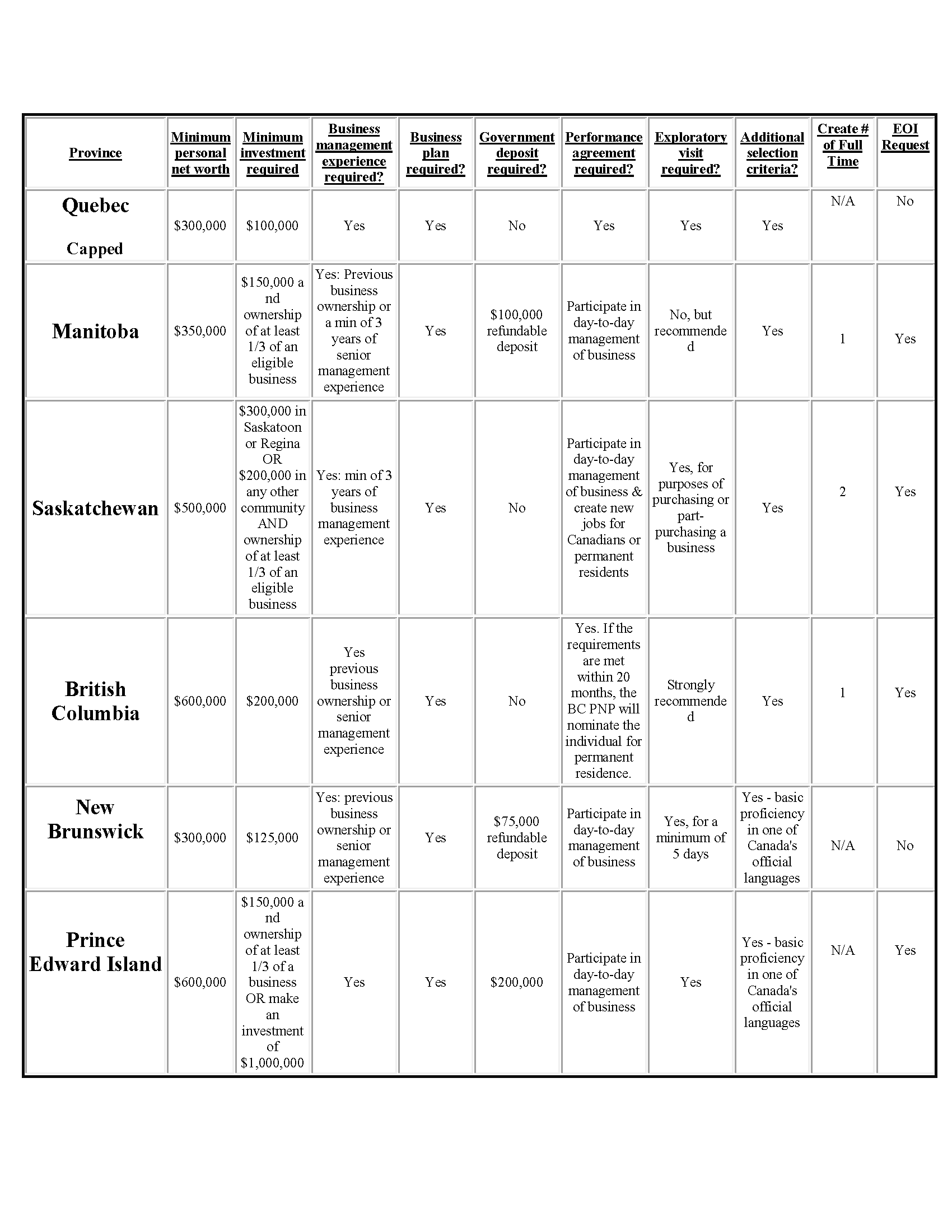
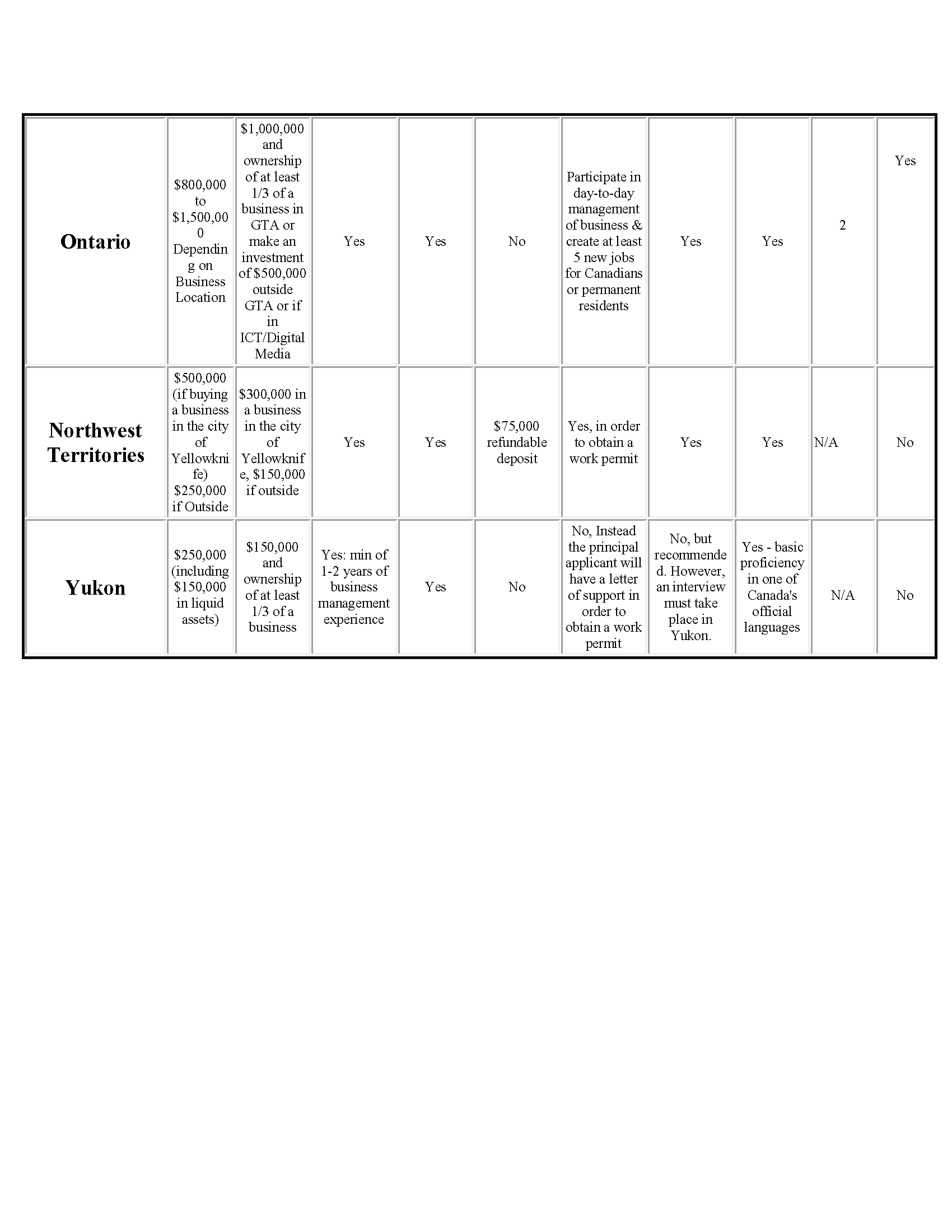
Canada Provincial Nominee Programs Chart

January 9, 2016 nkic

Here is a brief look at the current Provincial Nominee Programs available in Canada:

Canada's Provincial Nomination Programs - Page 1

Canada's Provincial Nomination Programs - Page 2


Posts navigation

← Previous 1 … 30 31 32 … 50 Next →
NK Immigration Consultants > News

Questions?

Please Contact Us

Follow Us!

Like UsJoin UsFollow Us

Global Immigration Consulting Services

Quick Links

  • NKIC Immigration Consultants
  • Canadian Immigration Programs
    • Canadian Permanent Residence Programs
      • Express Entry
        • Federal Skilled Workers
        • Federal Skilled Trades Program
        • Canadian Experience Class
      • Self-employed Persons
      • Start-up Visa
      • Live-in Caregivers
      • Family Sponsorships
      • Refugees
    • Canadian Temporary Residence Programs
      • Visit Canada
      • Study in Canada
      • Work in Canada
    • Provincial Nominee Programs
      • Alberta PNP
      • BC PNP
      • Manitoba PNP
      • New Brunswick PNP
      • Newfoundland and Labrador PNP
      • Northwest Territories Nominee Program
      • Nova Scotia PNP
      • Ontario PNP
      • PEI PNP
      • Saskatchewan PNP
      • Yukon PNP
    • Quebec Immigration
  • Services
    • School Programs
      • Simon Fraser University
      • The University of British Columbia
      • British Columbia Institute of Technology
      • The University of Toronto
      • Geneva Business School
    • Citizenship by Investment Programs
      • Antigua and Barbuda Citizenship by Investment Program
      • Cyprus Citizenship by Investment Program
      • Dominica Citizenship by Investment Program
      • Grenada Citizenship By Investment Program
      • St. Kitts and Nevis Citizenship by Investment Program
    • European Union Immigration Programs
      • Bulgaria Immigration Program
      • Cyprus Immigration Program
      • Hungary Immigration Program
      • Portugal Immigration Program
      • UK Immigrant Investor Program
    • USA EB-5 Immigration Program
  • News
  • About Canada
  • About Us
  • Contact Us
Proudly powered by WordPress